Why Tennis Scores Move from 30 to 40
Why tennis scores move from 30 to 40 becomes clear when you track each point, read the server’s score first, and follow deuce through advantage.
Why tennis scores move from 30 to 40 is easiest to understand by following one game point by point: the numbers name the score within a game, not the score of the match. The unusual sequence—love, 15, 30, 40—sets up a special rule at 40-all, where a player must win two points in a row to close the game.
Start with the game
Tennis uses several layers of scoring. Points build a game, games build a set, and sets build a match. Keep those layers separate when you read the scoreboard: a display may show the current game score alongside the number of games in the set.
A game begins at love, which means zero. The first point won by either player moves that player’s score to 15; the next moves it to 30; the third moves it to 40. Win the next point with a lead of two points, and you win the game.
- Neither player has won a point: love-love.
- One player has won a point: 15-love, or love-15.
- Both have one point: 15-all.
- One player has two points and the other has none: 30-love, or love-30.
- Both have two points: 30-all.
- One player has three points while the other has two: 40-30, or 30-40.
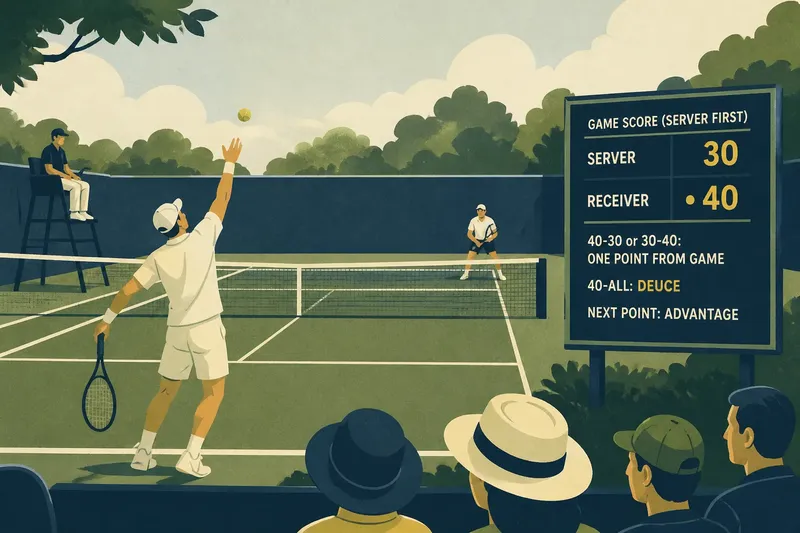
To read a spoken score, note the server’s points first. If the server has 30 and the receiver has 40, the score is “30-40,” and the receiver needs the next point to win the game. If both have won three points, the score is called deuce instead of “40-all.”
Read the unusual numbers
The labels are not a count you can add up in the ordinary way. A player who has won three points is shown at 40, not 45, and a player who has won four points may still be at 40 if the game has reached deuce. The point total continues to matter, but the display changes to show the contest’s current state.
So why does the count go 15, 30, then 40? The precise historical reason is uncertain, and common explanations differ. For following a match, the useful fact is simpler: learn the sequence as a set of labels, then pay close attention once both players reach 40.
Follow deuce and advantage
At deuce, neither player has the two-point lead needed to win. The next point gives its winner advantage, often announced as “advantage server” or “advantage receiver.” That player is one point from the game, while the opponent must win the following point to return the score to deuce.
If the player with advantage wins the next point, the game ends. If the opponent wins it, the score returns to deuce. This cycle can repeat, so a game may continue through several deuces before either player gets the consecutive points needed to finish it.
Say you are watching and the server has just won a point at deuce. The chair umpire calls “advantage server,” so the server can take the game with the next point; if the receiver wins that point, the score goes back to deuce. Watching for that single change tells you more than trying to calculate a running point total.
Why does tennis use 40?
Why not count 1, 2, 3, and 4?
Tennis uses traditional score calls rather than ordinary counting within a game. Treat love, 15, 30, and 40 as the names you need to recognize; you do not need to convert them into another system to follow the action.
What does love mean?
Love means a player has not won a point in the current game. It does not mean the player has lost the set or match, and the score starts over at love for each new game.
What is the difference between 40-all and deuce?
They refer to the same situation: both players have reached 40, after each has won three points. In ordinary spoken scoring, the call changes to deuce at that point.
When does advantage end?
Advantage ends when its holder wins the next point and takes the game, or when the other player wins and sends the game back to deuce. There is no lasting advantage from an earlier point if the opponent levels the score.
Track a live game
Use this order while watching, whether you are listening to commentary or checking a scoreboard:
- Identify the server. The server’s score is normally called first.
- Listen for love, 15, 30, and 40, and keep each player’s score separate.
- At 40-30 or 30-40, notice that the player at 40 needs one more point to win the game.
- At 40-all, switch to listening for deuce and advantage rather than expecting the display to climb past 40.
- After an advantage call, watch the next point: a win for the advantaged player ends the game; a win for the other player restores deuce.
- Once the game ends, move your attention to the game count in the set. The point score resets for the next game.
For instance, imagine a scoreboard shows the server at 30 and the receiver at 40. The receiver wins the next point, so the game ends; if the server wins it instead, the score becomes 40-all, or deuce. The observable distinction is whether that next point completes the game or starts the deuce-and-advantage sequence.
Keep the rule in view
The shortest way to follow tennis scoring is to remember the ordinary path—love, 15, 30, 40—and the exception that matters: at deuce, one point creates advantage, but only the next consecutive point wins the game. The calls make sense once you track who has the lead and whether that lead is enough to finish.
Do not spend match time trying to settle the exact origin of the labels; it is not needed to read the score correctly. Keep the server-first order in mind, and when you hear “advantage,” focus on the next point: it decides the game or sends both players back to deuce.