How Lawn Tennis Took Shape as a Modern Sport
Learn how lawn tennis developed from earlier racket games into an organized sport, with a clear account of the clubs and rule-making that shaped it.
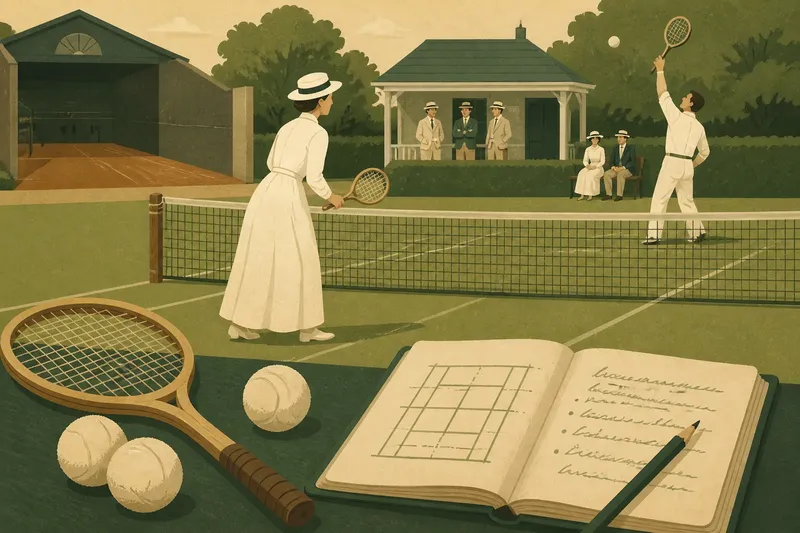
Lawn tennis took shape when players began adapting racket games for open-air play and organizers worked to make matches repeatable. The history of lawn tennis is less a single invention story than a shift from local pastimes toward a shared sport, with clubs and rule-making helping that change along.
Earlier racket games
Real tennis, also called court tennis in some places, was played in enclosed courts. Walls and architectural features could affect the ball, and the game’s specialized setting made it quite different from playing on an open lawn.
Lawn tennis removed those architectural features from the contest. Players faced one another across a net, and the ball’s path depended on strokes, bounces, and the boundaries of the playing area rather than on walls.
Garden play
Open-air racket play suited gardens and other informal spaces, where people could arrange a net and adapt play to the ground available. Those local arrangements made the activity approachable, but they also meant one group’s conventions might not match another’s.
Imagine a household with a net, rackets, and a level stretch of lawn, but no agreed court layout. The players first settle where the playing area ends and how a serve begins; the result is a playable local game, though a visitor may need those rules explained before joining.
Clubs and shared rules
Clubs gave players a place to meet regularly and organize contests. A written set of local rules could help members learn the same procedures, but agreements at one club did not necessarily govern play elsewhere.
As clubs and organizers sought matches that could be understood beyond a single group, common conventions became more useful. Rule-making helped reduce disputes over how play should proceed and made it easier to compare contests held in different places.
From pastime to sport
The transition was gradual rather than the work of one simple change. Open-air play provided a different setting from enclosed court games; clubs supported regular contests; and shared rules helped make the activity recognizable across venues.
That development also altered tennis’s social character. A garden pastime could be arranged informally, while organized competition called for agreed procedures and a clear way to determine a winner. The game’s spread depended on both: people could play locally, then recognize the same broad contest elsewhere.
What shaped tennis history?
What came before lawn tennis?
Real tennis was an earlier racket game played in enclosed courts, where walls and architectural features influenced play. Lawn tennis shifted the contest into open space, placing the net and players’ strokes at the center.
Why did lawn tennis develop in gardens?
An open lawn could host a social racket game without a purpose-built enclosed court. Local players could adapt the setup to their space, although those variations made shared rules more useful later.
How did clubs affect lawn tennis?
Clubs supported regular play and organized contests, giving members a place to teach and follow local conventions. Wider agreement among organizers helped make matches more comparable across venues.
Was modern lawn tennis created at one moment?
No single moment accounts for every feature of the sport. Its recognizable form emerged through the gradual interaction of open-air play, club competition, and efforts to establish shared rules.
Historical details worth keeping
- Setting: If a source describes an enclosed court with walls affecting the ball, treat it as a different setting from open-air lawn play; otherwise, check whether it is discussing a later outdoor form.
- Local rules: If an account says a club used its own conventions, read that as evidence of local variation; if it describes shared rules, ask which organizers or players adopted them.
- Organized matches: If a source mentions regular club contests, look for how the rules were communicated; if it gives no such detail, avoid assuming every venue played identically.
- Origins: If an account names one person or event as the sole beginning, seek context about earlier racket games and local play; if it acknowledges several influences, preserve that gradual framing.
- Changing forms: If a source separates garden play, club competition, and standardization, use those as connected phases rather than as wholly unrelated sports; if it treats them as identical, note the differences in setting and organization.
- Historical certainty: If a claim gives a precise date or rule change, verify it with a reliable tennis-history source before repeating it; if that verification is unavailable, describe the development without adding an unsupported date.
Say you are writing a short museum caption and have only three notes: an enclosed court game used walls, a later pastime was played outdoors, and clubs held organized matches under local conventions. First, separate the enclosed setting from the open-air one; next, describe the clubs as organizing play rather than inventing a single founder; then explain that common rules helped matches become more comparable. The resulting caption gives readers a defensible sequence while leaving precise dates and individual claims for source checking.
For a clear account of lawn tennis history, keep the focus on the change in setting and organization: open-air play made a different kind of contest possible, clubs helped make it regular, and shared rules helped people recognize it across locations. It is not worth forcing every development into a neat origin moment; the gradual story is both more cautious and more useful.