Your First Tennis Tie-Break: Follow the Scoreboard Without Losing the Thread
Follow a tennis tie-break scoreboard by tracking points, serving turns, and end changes, so you can tell who serves next and whether the match is finished.
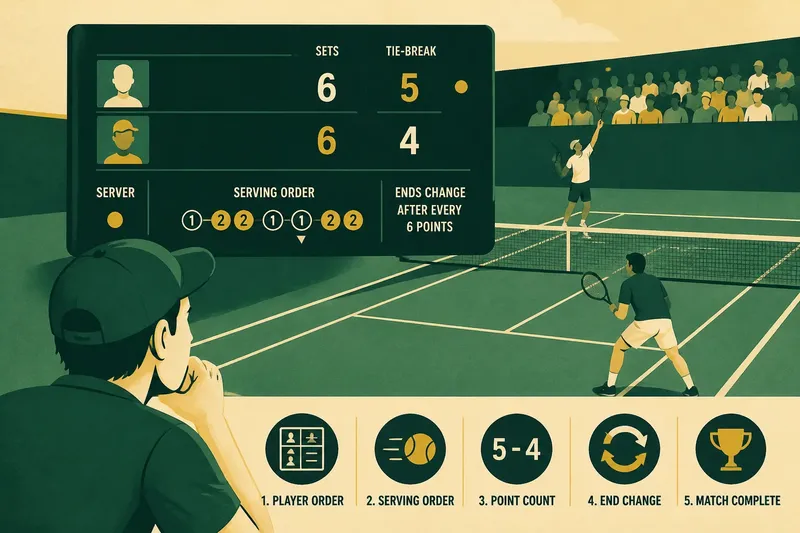
A tennis tie-break scoreboard is easiest to read when you track the point count, the serving order, and the ends separately. Start by identifying the players’ display order, then keep those same names or rows in view as the score changes.
Start with the set score
Before the tie-break begins, check the set score and listen for the chair umpire’s announcement. In a standard set tie-break, a player must reach at least seven points and lead by two. If the score reaches six points each, play continues until someone has that margin.
The set score and tie-break score answer different questions. A display might show the set tied at six games each, with tie-break points listed separately. The six-all set score does not mean the tie-break itself is six-all; look for the smaller point figures or a tie-break indicator.
Identify each player by name or flag before reading the point figures. Scoreboards can place players in different positions, so do not assume that the left-hand number always belongs to the same player across broadcasts.
Read the point count
Tie-break points use ordinary numerals. If the board shows 4–3, the player listed first has four points and the other has three. The figures follow the player order shown on that display.
A tie-break does not use the love, 15, 30, 40 sequence of a regular game. Each point won advances that player’s tie-break total by one. If the display has not updated, use the rally result only as a temporary clue and confirm the score once the point is recorded.
Watch for a two-point lead near the finish. At 6–5, the player ahead has not won; the opponent can still level the score. At 7–5, the leader has the required margin in a standard first-to-seven tie-break, while 7–6 remains live.
Follow the serving order
The player who serves the opening tie-break point serves just that one point. The opponent serves the next two, then the opening server serves two, and the two-point turns continue to alternate.
To track the pattern, note who served the first point. After that, count in pairs: the player who served first gets the second two-point turn, the opponent gets the next, and the sequence continues to alternate. A small dot, ball icon, or highlight may mark the server; check the display rather than assuming every tournament uses the same symbol.
If you arrive after play has started, the current score alone does not identify the server unless you also know who served the opening point. Look for a server marker or listen for the umpire’s announcement. If neither is available, wait for a clear cue rather than reconstructing the order from an uncertain score.
Know the end change
In a standard tie-break, players change ends after every six points have been played in total. The first change comes after the combined score reaches six, then again after twelve, and so on. At 4–2, for example, six points have been played and the players change ends before the next point.
The score and serving order continue through the change. Switching sides does not create a new serving turn or reset the point count.
Use the end change as a chance to reset your notes: check the score, identify the next server, and confirm the player order on the board. This is more useful than trying to infer the score from players’ court positions.
Use a viewing routine
When a tie-break begins in front of you, check these details as play progresses. Each observation points to a clear next action:
- Player order: If the names or flags are clear, keep that order for every score update; if they are not, identify both players before interpreting the figures.
- Opening server: If you see who serves the first point, note that player; if you miss it, use the server marker or umpire’s announcement instead of guessing.
- Point result: If the rally winner is clear, check that player’s total advances; if the board has not updated, wait for confirmation before treating the displayed score as current.
- Serving turn: If the opening server and current point count are known, follow the one-point opening turn and alternating two-point turns; if either is unknown, rely on the server cue.
- End change: If the combined score reaches six, twelve, or another six-point interval, expect a change of ends; if the players stay put, check whether the format differs from the standard tie-break.
- Match point: If a player has at least seven points and leads by two, the standard tie-break is complete; if the lead is only one point, keep watching because play continues.
- Set update: If the board advances the set score after the point, treat the tie-break as finished; if it still shows tie-break points, confirm that the final score has registered.
Say you join a standard tie-break at 5–4, with the second-listed player due to serve and the opening server unknown. You cannot determine the next server after that point from the score alone, so you watch for the server marker. If the second-listed player wins, the score becomes 5–5; the next server is still uncertain from those facts alone, so you use the marker or umpire’s announcement to identify the next turn rather than assuming. If you then learn that the first-listed player served the opening point, the sequence at ten points played puts the first-listed player in the next two-point turn.
Questions about tie-breaks?
Does the player at seven points always win?
No. In the standard first-to-seven format, the player must also lead by two points. A score of 7–6 continues, while 8–6 ends the tie-break.
Who serves the first point?
The player due to serve first in the tie-break serves one point, from the right-hand side of the court. The opponent serves the next two points, beginning from the left-hand side.
Why do players change ends?
Players change ends after every six points played in a standard tie-break. The change does not reset the score or alter the serving sequence.
Can a set tie-break use another format?
Yes. Some competitions use a different tie-break format, including a longer deciding-set tie-break. Check the event’s rules or scoreboard instructions if the announced target or end-change pattern differs from the standard format described here.
Keep the signals separate
The point figures tell you the score, the server marker identifies whose turn is coming, and the six-point rhythm signals an end change. If one of those cues is missing, use the others carefully and wait for an announcement or display update rather than treating a guess as fact.
For your first tennis tie-break, the useful habit is to record who served the opening point whenever you see it. That small note lets you reconstruct the serving turns later; if you missed it, the server indicator is the better guide.